Planned Lines
Numerous lines in Taiwan have been planned over the years. However, I would like to take a closer look at only five of them: a cross-country link that has been planned for over a hundred years, which will probably never be implemented, and four relatively current projects whose chances of implementation are slightly better.
The planned lines are described in more detail below. Please click on the headings to expand the areas.
Zhongheng Railway
In 1896, a Japanese survey team had already searched for a diameter line that would cross the island from west to east. However, the obstacles formed by mountain ranges with heights of 3,000m and more were too big. Nearly 30 years later, a second plan for a diameter line was drafted in 1923. The realization was first postponed and finally the plans were dropped due to the start of WW II. The TRA made a third attempt after the war for a 122km long line from Taichung to Hualien. As more than 50% of the line would have been in tunnels, the costs were too high and the TRA decided to build the North Link Line to connect the isolated East Coast Line with the railway network.
 Figure 1: As early as the end of the 19th century, the Japanese occupiers began on surveys for a central diameter line to connect the remote east coast with the densely populated west coast, but quickly saw the hopelessness due to the required crossing of mountain ranges up to nearly 4,000m high. After the Second World War, the plans were revived, particularly for strategic reasons. However, it was finally decided to connect the isolated Taitung Line on the east coast with the North and South Link Line along the eastern coastlin (Terrain by Stamen.com)
Railway lines to the east (Mountain/Taichung Line), south (Chengzhui Line) and the west (Coast section of Western/Trunk Line) surround the agglomeration of Taichung. A section between Dajia and Houli would be the missing link for a circle line around the agglomeration of Taichung. There has already been a sugar railway line between Dajia and Houli since 1 July 1912. However, the line was closed and the track bed is not available anymore. The construction of a new 13.4km long line would cost around 2 billion EUR. Thus, the government rejected the plans in 2019.
 Figure 2: An expansion of rail-bound suburban traffic in the greater Taichung area has been planned for a number of years. A northern cross connection between the coastline section of the Western Line from Dajia to Houli on the Mountain Line is missing for a ring line. Once there was even a sugar railway line here, but it has long since been dismantled. The route would have to be built largely on stilts through a densely populated area, which would make the short, almost 14km long route very expensive (more than 1 billion euros in construction costs!). Implementation of the plans is therefore rather uncertain at the moment (Terrain by Stamen.com)
The TRA made good experiences with the connection of high-speed station lying far outside the city centres (see Liujia and Shalu Line above). This now also planned for Changhua THSRC railway station, which should be connected with the TRA network at Tianzhong on TRA’s Western/Trunk Line. Construction seems to have started in 2019; the line should open in 2025.
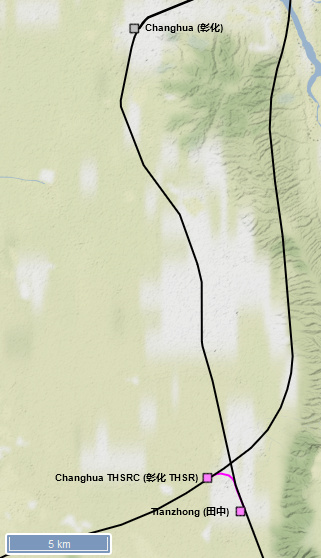 Figure 3: In Hsinchu (Liujia Line) and Tainan (Shalun Line), new branch lines were built in cape gauge in 2011 to connect the remote high-speed stations directly to the conventional railway network and thus offering a direct link to the city centers. Something similar is planned in Changhua. The request for proposal for the short Tanaka Line has probably already been issued, and implementation will most probably take place in the next few years.(Terrain by Stamen.com)
The city of Hengchun on the southern tip of the island is a popular tourist destination. First plans to build a railway line from Kaohsiung to Hengchun already occurred in 1876. However, only the Japanese started to build the railway line. By the end of WW II, the line had only reached Fangliao, which remained a terminus for a long time. Feasibility studies for the construction of the South Link Line foresaw an alignment via Hengchun as one opportunity. Due to the high cost, an alignment further north was built. Growing tourism with endless traffic jams and the isolation of Hengchun after a typhoon in 2005 gave the local politics arguments to construct a railway line. The Government finally agreed to the construction of a branch line from Neishi to Hengchun. Construction works started in 2019; by 2026 direct trains from Zuoying to Hengchun should allow travel times between Taipei and Hengchun in less than four hours.
 Figure 4: The city of Hengchun on the southern tip of the island of Taiwan is very popular with tourists, but is currently not accessible by rail. During the Second World War, the Japanese occupiers only extended the Pingtung Line to Fangliao. When the railway ring ling around the island was closed in the late 1980s / early 1990s with the construction of the South Link Line, it was decided to take a northern route and Hengchung remained without it rail connection. But this should change now. A nearly 40km long route is planned to connect Hengchun with Neishi on the South Link Line, the construction work has allegedly already started (Terrain by Stamen.com)
The Yilan Line that connects the agglomeration of Taipei with the east coast takes a curvy detour around the northern tip of the island. In order to increase capacity of the line, reduce travelling time and provide alternatives to the congested roads, the government started plans for a direct line between Taipei and Yilan. Both plans for a TRA line built in cape gauge as well as a high-speed line (extension of the existing high-speed line) are under discussion. Initially, the cape gauge line was the favourite, now there is a tendency towards the high-speed line. As most of the variants cut underneath a water reservoir essential for the water supply of Taipei, the plans raise a lot of concern. A realization of the plans is still far away.
 Figure 5: Today, the northern east coast can only be reached by rail from the capital Taipei with a detour via the winding Yilan Line, the direct road connection is overloaded. Thus, there are plans to build a direct railway line. Different variants are under discussion ranging from a cape gauge connection to an extension of the high-speed rail route from Taipei to Yilan. Almost all variants have in common that due to the topography they have to run largely in tunnels and under a reservoir, which is extremely critical for the drinking water supply of Taipei. Thus, the plans are unlikely to be implemented in the upcoming years (Doraemon.tvb, CC BY-SA 4.0