History of Railways on Taiwan Island
The first railway lines (1877 - 1894)
The very first railway line on Taiwan Island was built 1877 in a coal mine in Badouzi (八斗子) near Keelung (基隆) on the northern tip of the island. It ran from the mine located next to the sea to a small harbour. Waggons were pulled/pushed by humans or horses, locomotives were not used. The mine was destroyed as a pre-emptive measure when the French attacked Keelung in 1884. The Empire of China was reluctant towards technical innovations like railways (e.g. the first railway line in mainland China built by the British in Shanghai in 1876 had to be removed after a few months upon request of the Imperial Administration). The island of Taiwan was slightly excluded from this policy, e.g. the island was already opened in 1858 for foreign trade. Thus, Chinese merchants in Taiwan purchased the rails that were left over from the unsuccessful British attempt in Shanghai and tried to build a railway line between Kaohsiung (高雄) and Tainan (臺南). But the lack of experience and financial resources lead to a quick failure of the project.
It took several more years until the first “real” railway line went into service. After the successful defence of the island against French attacks in 1887, the Chinese Emperor raised the status of the island from a prefecture to a province. The first governor Liu Mingchuan immediately started a modernization program, which included the construction of a railway line between the harbour in Keelung (基隆) and the city of Taipei (台北). The government took care of land acquisition while construction and operations of the railway were handed over to a British dominated company from Shanghai (Shanghai Deshang Tailai International Co., Ltd.), as the government had no experience with railways. However, the government was unhappy with the company's work so far and soon took over the responsibility for construction and operations of the railway. A German engineer named Becker supported the government in the construction of the railway. The tracks were laid in 1,076mm gauge (cape gauge) which became the standard for all governmental railway lines in Taiwan except the East Coast Line from Taitung (臺東) to Hualien (花蓮), which was initially constructed with 762mm gauge and only re-gauged to 1,067mm in 1982 (!).
On the 25th August 1888, the first train ran on the first finished section of tracks within the area of Taipei. A 0-4-0T steam locomotive manufactured by Hohenzollern from Germany pulled the train. In 1888, Hohenzollern had delivered this and another locomotive of the same type to Taiwan; both were initially used for construction works along the line. However, further works did not advance as planned, as the terrain required the construction of tunnels and more than 60% of the workers died from diseases or heat strokes. The army stepped in and soldiers supported the construction works. However, the army often ignored survey advices, e.g. the largest tunnel was drilled from both sides, but the teams missed themselves by more than one metre. Finally, in November 1891 the first train ran on the around 30km between Taipei (台北) and Keelung (基隆). The trains were operated by British engine drivers until sufficient local personnel was trained. Alongside the two 0-4-0T locomotives from Hohenzollern, three 2-6-2ST engines from Hawthorn and 14 passenger coaches formed the initial rolling stock of the railway.
 Figure 1: The first two locomotives used on Taiwan Island were two tank engines built in 1888 by Hohenzollern in Germany (manufacturer numbers 444 and 445). They were named „Teng Yung“ („Rider of the sky“) and „Yu Fong” (“Rider of the wind”). Both were initially just used for construction of the first railway line and had just small storage tanks. The tanks were enlarged later on and the chimney was replaced. The locomotives remained in service until 1924 mainly for shunting services. “Yu Fong” was dismantled and sold in parts whereas “Teng Yung” was conserved and is meanwhile put on display in front of the National Museum in Taipei.
 Figure 2: This old photograph shows the main station in Taipei shorty after its opening. On the left, there are two of the three saddle tank engines delivered by Hawthorn in 1889. The locomotive in the centre is one of the two Hohenzollern engines. Thus, the photograph shows 60% of the initial fleet (The original uploader was Aco at Chinese Wikipedia., Public domain, via Wikimedia Commons).
 Figure 3: This old photograph shows a section of the line between Keelung and Taipei shortly after its opening. The locomotive is one of the three Hawthorn saddle tank engines that initially operated the trains between Keelung and Taipei (臺灣總督府交通局鐵道部 (Taiwan Governor-General), Public domain, via Wikimedia Commons).
 Figure 4: One of the Hawthorn saddle tank engines at Taipei (?) station. Initially, the railway operated three of those saddle tank engines built by Hawthorn in 1889. A further three engines of that type followed in 1893 (臺灣總督府交通局鐵道部 (Taiwan Governor-General), Public domain, via Wikimedia Commons).
Works on the railway line to the west and south of Taipei also started alongside the construction of the line from Taipei northwards to Keelung. A 425m long wooden bridge across the Tamsui (淡水) River in Taipei was already opened 1889. The rails reached Taoyuan (桃園) in November 1891, Zhongli (中壢) in July 1892 and the final stretch to Hsinchu (新竹) in June 1893 forming an 80km long extension from Taipei towards the south. A planned prolongation to Kaohsiung (高雄) was not realized due to missing funds as the construction of the railway line from Keelung to Hsinchu had eaten up the complete government funds.
 Figure 5: This old photograph shows the wooden bridge across the Tamsui River in Taipei. The bridge was replaced shortly after the occupation by the Japanese in 1895 (Unknown author, Public domain, via Wikimedia Commons).
| Line | From | To | Length (km) | Opening date |
| Western/Trunk Line | Keelung (基隆) | Taipei (台北) | 28.3 | November 1891 |
| Taipei (台北) | Taoyuan (桃園) | 29.1 | November 1891 | |
| Taoyuan (桃園) | Zhongli (中壢) | 9.9 | July 1892 | |
| Zhongli (中壢) | Hsinchu (新竹) | 39.1 | June 1893 | |
| 106.4 |
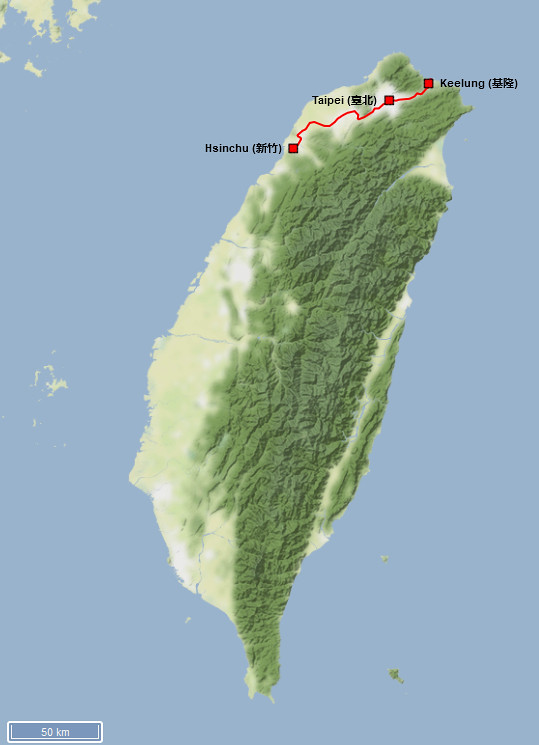 Figure 6: The railway network on Taiwan Island in 1893 (relief by Stamen).
When the Japanese army took over control of the island in 1895, they found a railway line in a rather miserable state. As the railway was of strategic importance, the army took over the control of the railway and immediately started with improvements. Rails and sleepers were replaced, grades were eased and sharp curves were removed. This partly led to a complete new alignment of the line between Keelung and Taipei. The army also requested a quick extension of the existing line to Kaohsiung as the Japanese occupation initially lead to uprisings and insurgencies throughout the island. Due to missing funds, the new government was unable to construct the extension. Thus, the army started to build a railway line from Hsinchu to Kaohsiung using a light railway system from the French Decauville company with 500mm gauge. Waggons on this line were pushed by humans, locomotives were never used. This light railway became the starting point for the many push-cart lines that later sprouted throughout the island in the first quarter of the 20th century (see Non-Governmental Railways).
 Figure 7: The new station building of Taipei Station built by the Japanese after the occupation of the island (The original uploader was Aco at Chinese Wikipedia., Public domain, via Wikimedia Commons).
 Figure 8: The Daud River Bridge right after the opening of the trunk line (臺灣總督府鐵道部, Public domain, via Wikimedia Commons).
 Figure 9: The new station building of Keelung Station built by the Japanese after the occupation of the island (Unknown author, Public domain, via Wikimedia Commons).
Further attempts to build the extension to Kaohsiung initially failed. As the government lacked sufficient funds, it tried to build the line with private funds. However, an initiative of Japanese industrials was unsuccessful as well as the foundation of a joint stock company which did not raise sufficient public interest. Initiatives to build further railway lines on Taiwan Island also failed as the geographic obstacles were too high or simply because aborigines killed the surveillance teams. Meanwhile in 1897, the army had handed over the control of the railway line between Keelung to the newly formed Japanese government of Taiwan. As all private attempts to build the extension to Kaohsiung finally failed, the governor decided to build the line by issuing public bonds. The governor created a Ministry of Railways in 1899, which took over the existing railway and started construction of the extension.
Work started from both sides. A new harbour was constructed in Kaohsiung and the first and southernmost section between Kaohsiung Harbour and Tainan (臺南) was already opened on 29th November 1900 as it ran through flat plains and did not cross any major rivers. Around four years later, the section between Tainan and Changhua (彰化) was officially opened. Regarding the remaining section, there were long discussions on the alignment between Zhunan (竹南) and Changhua (彰化). One alternative route would lead along the sparsely populated coastline whereas, the second alternative would pass through Taichung (台中), already one of the largest cities on Taiwan at that time. The latter alternative was chosen even though it ran through a mountain range, which required constructions of several large bridges and tunnels.
The construction works came to a more or less standstill after the outbreak of the Russo-Japanese War on 8th February 1904. As the Russian Tsar had sent his Baltic Fleet towards the east passing the island of Taiwan, the Japanese Army constructed several temporary branch lines from the trunk line towards the western coast line. Material and workers planned for the construction of the trunk line were assigned to the construction of these temporary lines. By then, the northern section between Hsinchu (新竹) and Sanyi (三義) had already started business in 1903 to Miaoli (苗栗) and 1904 to Sanyi (三義) whereas the southern section had reached Changhua (彰化) in 1904 . After the Japanese victory, the construction resumed. However, passing the mountain range between Sanyi (三義) and Taichung (台中) proofed to be difficult and this remaining section was only opened in 1908. Nearly 20 years after construction works for the first sections between Taipei and Keelung had started, the nearly 400km long Trunk/Western Line from Keelung down to Kaohsiung finally went into operation. The biggest cities on the island were now connected to the railway and the Trunk/Western Line played an important role in the further development of the island.
.jpg) Figure 10: As long as some sections of the Trunk/Western Line were not finished, light railways filled the missing gaps. Often built by the army, those light railways were not operated by locomotives. Instead, the waggons were pushed by humans. This old photograph shows the light railway between Bogong and Huludun crossing the Da’an River (Unknown author, Public domain, via Wikimedia Commons).
Figure 10: As long as some sections of the Trunk/Western Line were not finished, light railways filled the missing gaps. Often built by the army, those light railways were not operated by locomotives. Instead, the waggons were pushed by humans. This old photograph shows the light railway between Bogong and Huludun crossing the Da’an River (Unknown author, Public domain, via Wikimedia Commons).
 Figure 11: The Longteng Bridge is one of the largest bridges of the Trunk/Western Line. It was only finished in 1908 (author unknown / Public domain in Wikimedia Commons).
By the time the Trunk/Western Line went into operation in full length, two branch lines had already opened to traffic at the northern and southern end. Since 1901, the Tamsui Line connected the harbour at Tamsui (淡水) with Taipei. In Kaohsiung, a branch line was built eastwards to Jiuqutang (九曲堂) which later became part of the Pingtung Line.
| Line | From | To | Length (km) | Opening date |
| Western/Trunk Line | Tainan (臺南) | Kaohsiung (高雄) First station | 46.2 | 29.11.1900 |
| Tamsui Line | Taipei (台北) | Tamsui (淡水) | 21.2 | 25.08.1901 |
| Western/Trunk Line | Hsinchu (新竹) | Zhunan (竹南) | 19.0 | ??.??.1903 |
| Mountain/Taichung Line | Zhunan (竹南) | Miaoli (苗栗) | 15.2 | ??.??.1903 |
| Miaoli (苗栗) | Sanyi (三義) | 18.2 | ??.??.1904 | |
| Western/Trunk Line | Changhua(彰化) | Tainan (臺南) | 142.3 | 26.03.1905 |
| Pingtung Line | Kaohsiung (高雄) First station | Jiuqutang (九曲堂) | 16.9 | ??.??.1907 |
| Western/Trunk Line | Kaohsiung (高雄) First station | Kaohsiung (高雄) Harbour | 0.5 | ??.??.1908 |
| Mountain/Taichung Line | Sanyi (三義) | Changhua(彰化) | 54.5 | 20.02.1908 |
| 334.0 |
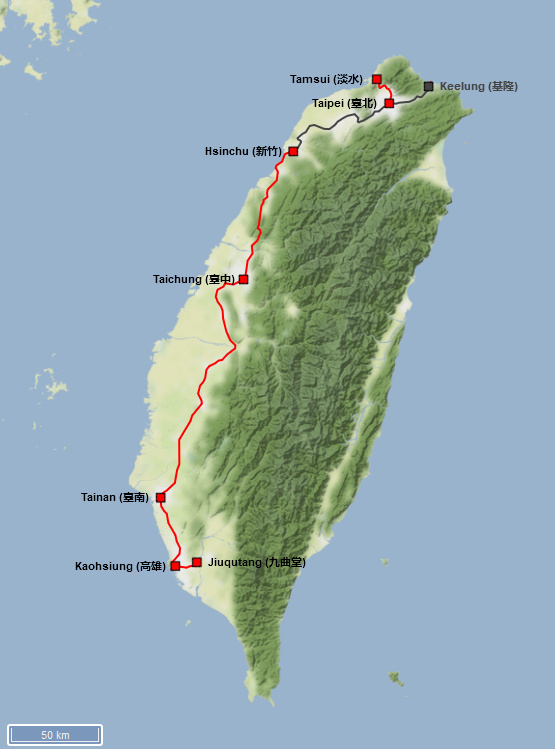 Figure 12: The railway network on Taiwan Island in 1908 (relief by Stamen). Lines marked in red were opened between 1900 and 1908, lines marked in grey had been opened before 1900.
The completion of the trunk line between Keelung (基隆) and Kaohsiung (高雄) triggered the development of the island and marked the start of industrialization on Taiwan Island. The Japanese started the large-scale cultivation of sugar cane in the fertile western plains and opened several large sugar mills. The northern part of the island offered vast resources of coal, gold and other minerals whereas the mountains where covered with thick forest. Especially in higher altitudes, abundant forests of old conifers and cypresses could be found, which were highly appreciated in Japan for the construction of temples and other buildings. The victories in the wars against China (1895) and Russia (1904/05) made Japan one of the main powers in Asia and the island of Taiwan had a very high strategic importance. Large railway projects including a ring line around the island as well as a central diameter line were planned. However, due to the lack of sufficient capital (a problem already encountered in the construction of the trunk line) only smaller parts of the high raising plans were realized. By the 1930s, the Government Railway had expanded their network only at the northern and southern ends of the trunk line. In addition, the isolated east coast line as well as some further branch lines enhanced the Government Railway network. On the other hand, smaller railways like the sugar, forest or mining railways were sprouting throughout the whole island. The influx of Japanese capital came to a more or less standstill after a terrible earthquake hit the city of Tokyo in 1923. After this event, no further large railway projects were started, even though the economy slightly recovered. The worldwide economic crisis hit the islands economy and its railways very hard. The railways were neglected; necessary investments and maintenance were often not performed anymore. At the preface of WW II most of the railways were already in a quite worn out state.
 Figure 13: The Japanese Crown Prince Hirohito visits the station of Hsinchu in 1923 (Unknown author, Public domain, via Wikimedia Commons).
Taiwan’s east coast is extremely rugged with high cliffs and a lack of natural harbours. Only between the cities of Hualien (花蓮) and Taitung (臺東) there is a valley (Huatung Valley) which offers land for agriculture. Due to the geographic difficulties and sparse population, initial plans for the construction of a ring line were abandoned. Instead, the construction of a railway line through the Huatung Valley was planned and finally started in 1907. In contrast to the remaining railway network, the Government Railway chose a gauge of 762mm for the construction of the East Coast/Taitung Line (the gauge was only altered to the standard 1,067mm gauge in 1982!). Construction advanced very slowly, the first sections were opened to public traffic only in 1917, and the complete line was only finished in 1926. The East Coast Line remained isolated for a very long time, only by the end of 1979 the North Link Line finally linked the East Coast Line to the Governmental railway network.
 Figure 14: This postcard shows a train on the East Coast Line shortly after its opening. The train is pulled by a 0-6-0T engine from Vulcan Iron Works (Unknown author, Public domain, via Wikimedia Commons).
The Government Railways expanded the Trunk/Western Line on both ends. The northern tip of the island is rich in minerals, especially coal. Thus, the Government Railway started the construction of the Yilan Line, which connected those coal deposits as well as the lowlands around the county of Yilan (宜蘭). First sections were opened in 1919, the complete Line from Badu (八堵) to Su’ao (蘇澳) finally opened to public traffic in 1924. On the southern end, the already existing extension to Jiuqutang (九曲堂) was prolonged bit by bit mainly for strategic reasons until it finally reached Nanzhou (南州) in 1923.
_Yilan_Train_Station_of_Taiwan.jpg) Figure 15: This old photograph dated from 1919 shows the station of Yilan and its employees shortly after its official opening (Unknown author, Public domain, via Wikimedia Commons).
Figure 15: This old photograph dated from 1919 shows the station of Yilan and its employees shortly after its official opening (Unknown author, Public domain, via Wikimedia Commons).
During the construction of the Trunk/Western Line, the Government Railways decided to align the track between Zhunan (竹南) and Changhua (彰化) through a mountain range in order to connect the city of Taichung to the railway network. However, with the growing traffic, this section soon became a critical bottleneck for the complete railway network. Due to the limited capacity (trains had to be split and pushed by additional engines), goods trains often were stocked up to several weeks. Thus, the alternative alignment along the coast, which was not built initially, was finally opened between 1920 and 1922 and offered a bypass to the now called Mountain/Taichung Line. The Government Railways also took over two branch lines that were initially built by private companies. The Pinxi (平溪) Line connected several coal mines to the Yilan Line. Opened in 1921, the line was taken over by the Government Railways in 1929. The Jiji (集集) Line was initially built for the construction of a large hydroelectric dam and power plant near Checheng (車埕). In operation since 1922, it was taken over by the Government Railways in 1927 after construction works were finished. Thus, by the end of the 1920s, the Government Railway operated a network of around 730km in cape gauge plus the isolated 170km long East Coast Line between Hualien (花蓮) and Taitung (臺東). Traffic was handled by around 200 steam locomotives (at the beginning imported from the UK, US and Germany; later mostly delivered by Japanese companies) as well as some Japanese steam and petrol railcars.
| Line | From | To | Length (km) | Opening date | Remark |
| Pingtung Line | Jiuqutang (九曲堂) | Pingtung (屏東) | 7.2 | ??.??.1914 | |
| Tamsui Line | Beitou (北投) | Xinbeitou (新北投) | 1.2 | ??.??.1916 | |
| Taitung Line | Yuli (玉里) | Hualien (花蓮) old station | 83.6 | 17.05.1919 | built in 762mm gauge |
| Taitung (臺東) old station | Guanshan (關山) | 36.5 | 16.12.1919 | built in 762mm gauge initially by Taitung Development Company; taken over by Government Railways shortly after opening | |
| Yilan Line | Badu (八堵) | Ruifeng (瑞芳) | 8.9 | ??.??.1919 | |
| Jiaoxi (礁溪) | Su'ao (蘇澳) | 30.7 | ??.??.1919 | ||
| Western/Trunk Line | Qingshui (清水) | Changhua (彰化) | 24.9 | 25.12.1920 | |
| Yilan Line | Ruifeng (瑞芳) | Houtong (猴硐) | 4.6 | ??.??.1920 | |
| Dali (大里) | Jiaoxi (礁溪) | 22.8 | ??.??.1920 | ||
| Chengzhui Line | Chenggong (成功) | Zhuifen (追分) | 2.2 | 11.10.1922 | |
| Western/Trunk Line | Zhunan (竹南) | Qingshui (清水) | 65.3 | 11.10.1922 | |
| Pingtung Line | Pingtung (屏東) | Xizhou/Nanzhou (南州) | 22.3 | ??.??.1923 | |
| Yilan Line | Houtong (猴硐) | Dali (大里) | 26.6 | 01.12.1924 | |
| Taitung Line | Guanshan (關山) | Yuli (玉里) | 37.8 | 25.03.1926 | built in 762mm gauge |
| Jiji Line | Ershui (二水) | Checheng (車埕) | 29.7 | ??.05.1927 | opened 14.01.1922 by Taiwan Power Co., Ltd.; taken over by Government Railways in May 1927 |
| Pinxi Line | Sandiaoling (三貂嶺) | Jingtong (菁桐) | 12.9 | 01.10.1929 | opened in July 1921 by Taiyang Mining Co., Ltd.; taken over by Government Railways on 01.10.1929 |
| 417.2 |
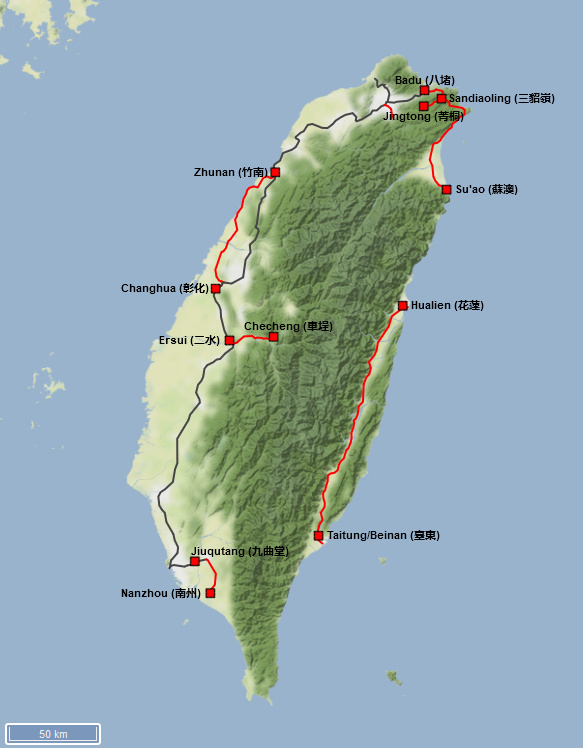 Figure 16: This map shows the Governmental Railway Network on Taiwan Island in 1936 (terrain by Stamen). Non-govermental railways like sugar or forest railways are not shown. Sections marked in red were built between 1909 and 1937, sections marked in grey were built before 1909. The railway network expanded at the northern (Badu (八堵) - Su’ao (蘇澳)) and southern (Jiuqutang (九曲堂) - Nanzhou (南州)) ends of the Trunk/Western Line and a bypass for the Mountain/Taichung Line was built between Zhunan (竹南) and Changhua (彰化) as well as the isolated East Coast/Taichung Line between Hualien (花蓮) and Taitung (臺東). In addition, to private branch lines (Pinxi (平溪) Line from Sandiaoling (三貂嶺) to Jingtong (菁桐) and Jiji (集集) Line from Ersui (二水) to Checheng (車埕)) were taken over by the Government Railways.
Traffic on the railway network grew rapidly until the beginning of the worldwide economic crisis at the end of the 1920s. The northern section of the Trunk/WesternLine between Taipei (台北) and Keelung (基隆) received its second track already starting from 1912 (finished in 1919)! Within the first twenty years after the opening of the Trunk/Western Line, traffic had already quadrupled. Between 1910 and 1930, passenger traffic grew by the factor of 6.1, goods traffic even by 6.7. However, the rolling stock only grew by 4.1. This shows that the necessary investments were neglected. It became even worse after the economic downturn in the late 1920s. Whereas hardly any roads were constructed in the first two decades of the Japanese occupation, the road network now expanded and funds were shifted from the railway towards road construction. The Governmental Railways could not even afford required maintenance of tracks and rolling stock. Due to the humid climate and the proximity to the sea, the rails had theoretically a maximum lifespan of 15 years. Nevertheless, at the beginning of the 1930s large parts of the railway lines still had the rails dating from their initial construction. Some railheads were already worn out by up to 13mm. Thus, the railways became more and more unreliable and traffic shifted from the railways to road transport. Finally, the Government started an investment program for the railways in the 1930s. Until 1936, around 40% of the rails were replaced and the sections Taipei (台北) - Zhunan (竹南) and Tainan (臺南) - Kaohsiung (高雄) were enhanced with a second track. The rolling stock was also outdated. It comprised mostly of steam locomotives constructed in the first quarter of the 20th century or even the 19th century, superheated locomotives were a clear minority. The Government Railways started to purchase JNR standard steam locomotives from various Japanese manufacturers (see chapter on steam locomotives for details), but deliveries came to a standstill after the break out of WW II. In 1936, the rolling stock of the Government Railways consisted of 209 steam locomotives, 497 passenger coaches and 4,278 goods waggons. Not the best starting point for the things to come.
 Figure 17: Students in the Taihoku (Taipei) Railway Depot just before the start of WWII. Locomotive no. 529 type 2-6-0 was built in 1923 at Kisha Seizo with manufacturer no. 737 (Unknown author, Public domain, via Wikimedia Commons).
Alongside the Government Railway Network, Taiwan had a large network of private railway lines like sugar, forest or mining railways as well as the unique push-cart lines (see chapter on Non-Governmental Railways for details). As for the Governmental Railways, those railways saw a rapid growth throughout the first two decades of the Japanese occupation. The sugar railway networks amounted up to 3,000km among which around 1,000km saw regular passenger traffic making the sugar railways network even larger than the Governmental Railway network (see chapter on sugar railways for details). The forest railways with often spectacular alignments also operated networks with an overall length of some 100km in length (see chapter on forest railways and chapter on Alishan Forest Railway for details). The manually operated push-cart lines comprised of lines with a total length of more than 1,300km (see chapter on push-cart railways for details). The sugar and forest railway lines mostly had a gauge of 762mm whereas the push-cart lines had gauges around 500mm. The economic downturn at the end of the 1920s hit the Non-Governmental Railways even harder than the Governmental Railways. Traffic figures often slumped by more than 50% and some of these railways (especially the push-cart lines) even closed before the start of WW II.
 Figure 18: At the beginning of the 20th century, the sugar industry and its connected sugar railways experienced a rapid growth. The sugar railway network finally a exceeded a total length of 3,000km (Unknown author, Public domain, via Wikimedia Commons).
In Asia, WW II had already started in 1937 with the Japanese attack on China. Taiwan played an important role in the expansion plans of the Japanese Army and this had a severe impact on the railways. Rolling stock was reclaimed by the army and partly transferred to the Chinese mainland where it was used after a re-gauging. Passenger traffic on Taiwan was reduced to a bare minimum and high taxes were imposed on tickets. Due to its geographic location, the island became a stepping stone in the invasions of the Japanese Army into the Pacific and Southeast Asia. Harbours, airports, refineries and war-relevant industries were built and connected to the railway networks with branch lines. Rails from non-war-relevant lines (e.g. the Xinbeitou Branch Line of the Tamsui Line) were taken to built such branch lines. In addition, the Pingtung Line was expanded along the southwestern coastline from Nanzhou (南州) to Fangliao (枋寮) with a branch to the harbour of Donggang (東港).
At the beginning, the Japanese military campaign in Asia was very successful. However, once the United States entered the war in the Pacific after the Japanese attack on Pearl Harbour, the tide started to turn. First slowly, then quicker and quicker. The Japanese now tried to turn Taiwan into a fortress that could withstand an Allied attack. Harbours and railway lines close to the coastline were dismantled (e.g. the section Linbian – Fangliao which was only built in 1941 was already dismantled in 1944) in order to prevent a landing of Allied troops on the island which in fact never happened. Instead, the US Army started to launch heavy air raids by the beginning of 1945 that heavily affected the railway lines. At the end of the war all major railway bridges were either destroyed or heavily damaged and 1,392 locomotives and waggons became unusable (48% of all locomotives and 20% of all waggons). Railway operations were forced to a more or less complete standstill.
 Figure 19: An US air attack on the railway station of Zhunan (竹南) in 1945 (Image by George Lane on flickr).
| Line | From | To | Length (km) | Opening date | Remark |
| Western/Trunk Line | Gushan (鼓山) | Kaohsiung (高雄) new station | 2.5 | ??.??.1941? | Relocation of Kaohsiung Main Station |
| Pingtung Line | Xizhou/Nanzhou (南州) | Fangliao (枋寮) | 18.0 | ??.??.1941? | |
| Donggang Line | Zhen'an (鎮安) | Donggang (東港) | 6.2 | 19.07.1940 | |
| 26.7 |
| Line | From | To | Length (km) | Closing date | Remark |
| Tamsui Line | Beitou (北投) | Xinbeitou (新北投) | 1.2 | ??.??.1944? | reopened 1946 |
| Pingtung Line | Linbian (林邊) | Fangliao (枋寮) | 11.2 | ??.??.1944 | reopened 1953 |
| 12.4 |
After the unconditional surrender of the Japanese Empire on 15th August 1945, the situation on Taiwan Island remained unclear at first. The Japanese governor continued to rule the island until first soldiers of the Chinese Republic (Kuomintang) arrived mid of October 1945 and took over control thus ending 50 years of Japanese occupation. However, many people saw the Kuomintang just as another occupying power of the island. Japan officially resigned its control over the island only in 1952 without officially handing it over to another country. By then, millions of Kuomintang and their followers (among them large parts of the economic and intellectual elite) had fled to Taiwan after the defeat against communist troops under Mao Tse-Tung on the mainland in 1949.
Before and during the war, Japanese had held most management and engineering positions within the Government Railways. Due to the unclear status of Taiwan, most of them remained on the island at first. Their knowledge was a big help during the reconstruction of the badly damaged railways. Only in June 1947, 5,300 Japanese employees of the Government Railways were sent back to Japan. The Government Railways were headed by a Railways Committee formed by the Kuomintang who tried to introduce practices and standards from the railways on the mainland. However, the employees refused to change the Japanese standards and until today the railways on Taiwan Island are strongly influenced by Japanese rules and standards (signals, rolling stocks, uniforms, processes etc. are quite similar to those of the JR).
 Figure 20: This photograph dated from the 15th November 1947 shows the staff of the Kaohsiung branch of the locomotive depot of the Taiwan Railway Administration Committee. Visible are locomotives no. 527 (Kisha Seizo, 1923, #735), no. 537 (Hitachi, 1927) and most probably 503 (Kisha Seizo, 1920, #418) (Public domain from Wikimedia Commons).
On 1st March 1948, the Railways Committee of the Kuomintang transferred into the governmental “Taiwan Railway Administration” (TRA) that controls large parts of the railways on Taiwan Island until today (now being part of the Ministry of Transportation). The forest and sugar railways were also transferred into governmental organizations (Forestry Bureau and Taiwan Sugar Corporation, now being part of the Department of Agriculture and Commerce). The state of the railways on the island was already not the best before the start of the war, it did not improve during the war and towards the end of the war, massive destruction came on top. A first investigation started after the Kuomintang had taken control of the railways showed that 150km of tracks and around 1,400 bridges and culverts were destroyed, every second sleeper was completely rotten and more than half of the locomotives were not in an operating condition. The secretary of the Railway Committee gave the railways a maximum of six months until it would break down completely. However, luckily the mostly Japanese employees and their expertise remained on the island and reconstruction advanced very fast. At the beginning of the 1950s, most of the lines and locomotives were reconstructed and building of new branch lines had started. Japan also delivered new steam locomotives, some being part of orders already placed before the war, others being reparations. They came just in time as the flight of millions of mainland Chinese posed tough transportation requirements on the railways.
 Figure 21: The steam locomotive CT277 was delivered in 1953 by Hitachi (manufatcurer no. 12102) as part of Japanese deliveries after war as reparations or orders placed before the war. Four locomotives of class CT270 survived, however CT277 is not among them (Photo by中國農村復興聯合委員會 / Public domain from Wikimedia Commons).
After reconstructions were mostly finished, the TRA started the construction of new branch lines. The first one was the Neiwan (內灣) Line. Construction of the line had already started during the war and was finally opened in 1951. The Shenggang (神岡) Line in 1957, a short branch line near Taichung that connected a military camp with the Mountain/TaichungLine, followed it. The 1950s also saw the introduction of new diesel railcars from Japan, which replaced the steam-hauled express trains between Taipei and Kaohsiung starting from 1957. With the help of US development aid, larger number of diesel electric locomotives from GM EMD were purchased at the end of the 1950s. As sugar and wood played an important role in the economic plans of the governments. Thus, sugar and forest railways were expanded and received new rolling stock. The sugar railways also played an important role in passenger transport in the first two decades after war until passenger traffic shifted to the roads.
 Figure 22: Personnel of Delegation of World Bank with Officials of Taiwan government in TRA 20FOB2001 Railcar. The World Bank and the United States finance the reconstruction and modernization of the railways on Taiwan island after WWII (Unknown author, Public domain from Wikimedia Commons).
 Figure 23: The expansion of operations required the Taiwan Sugar Industry to purchase new rolling stock. 45 steam locomotives were ordered in 1948 from Belgian manufacturers Franco-Belge and Tubize. No. 346 from Franco-Belge remained in working condition and hauls tourist trains at the former Xihu sugar factory (© Ralf Schellhammer).
| Line | From | To | Length (km) | (Re)Opening date | Remark |
| Xindian Line | Wanhua (萬華) | Xindian (新店) | 10.4 | ??.??.1945? | intially opened in 22.01.1921 as a private line for a coal mine. Taken over by the Government Railway after the war. |
| Tamsui Line | Beitou (北投) | Xinbeitou (新北投) | 1.2 | ??.??.1946 | reopening, dismantled during the war |
| Neiwan Line | Hsinchu (新竹) | Hexing (合興) | 24.4 | 27.12.1950 | |
| Hexing (合興) | Neiwan (內灣) | 3.5 | 11.09.1951 | ||
| Pingtung Line | Linbian (林邊) | Fangliao (枋寮) | 11.2 | ??.??.1953 | reopening, dismantled during the war |
| Shenggang Line | Tanzi (潭子) | Oil depot | 13.4 | 05.03.1957 | |
| 64.1 |
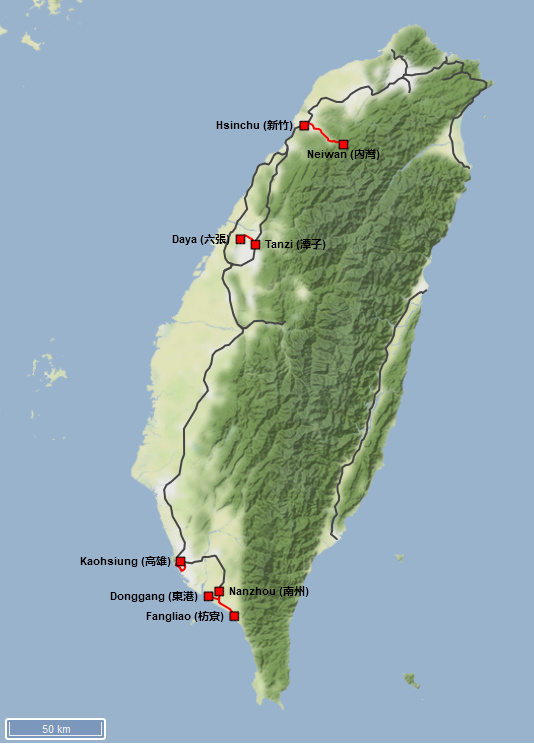 Figure 24: This map shows the Governmental Railway Network on Taiwan Island in 1958 (terrain by Stamen). Non-govermental railways like sugar or forest railways are not shown. Sections marked in red were built between 1937 and 1958, sections marked in grey were built before 1937. In the northern part, two new branch lines were opened after the war (Neiwan (內灣) Line in 1951 and Shenggang (神岡) Line in 1957). The expansions in the southern part of the island were opened during the war (harbour line in Kaohsiung and prolongation of the Pingtung Line to Fangliao (枋寮) with a branch to Donggang (東港); parts of the Pingtung Line were dismantled already during the war, but were reopened after the war).
The economic recovery after the war turned into an economic boom in the 1960s. The export shifted from agricultural goods like sugar and timber to manufactured goods like shoes, clothes and toys, later electronics. This also affected the railways. The growing need of the industry for electricity required the construction of new coal power plants, which were connected to the railway network for the supply with coal. On the other hand, the railways transported less raw materials like sugar or timber. The growing industry produced lightweight products and did not rely on the railways for transportation. Thus, transportation figures for goods slumped and triggered closures of branch lines mainly used for freight traffic, which were often only constructed some years before. On the other hand, the rising economy lead to a growing demand for fast passenger transport. Finally, plans that have been existed since pre-war time became reality. The Western/Trunk Line was finally electrified in 1979 and exactly 100 years after opening of the first railway line, the ring line around the island was closed in 1991. Alongside these internal changes, the railways were also confronted with external impacts. The Republic of China held the UN seat for China until 1971 when the Peoples Republic of China replaced it. Diplomatic relationships with most foreign countries shrank and it became more and more difficult to import rolling stock.
During the 1960s, the railway network expanded further. Already in 1959, the Dongshi (東勢) Line north of Taichung was opened to support the logging industry and construction of the first highway crossing the mountain range between the plains in the west and the east coast. The branch was short-lived; it was closed already in 1991. Two new branch lines connected coal power plants at the coast with the railway network. The Shen’ao (深澳) Line was opened in 1965 (prolonged to Liandong (簾洞) in 1967), the Linkou (林口) Line followed in 1968. Parts of the Shen’ao (深澳) Line were already closed ten years later. New ports near Taichung (台中), Hualien (花蓮) and Kaohsiung (高雄) were also connected to the railway network. After the Korea War, the USA changed their politics and tried to turn Taiwan into an anti-communist stronghold. The USA massively increased development funds and helped the railway to modernize. Diesel railcars from Japan and diesel-electric locomotives from the US enhanced the rolling stock and large parts of the steam locomotive fleet went out of service. In addition, a modern signalling system installed on the Western/Trunk Line allowed running more trains with higher speed.
 Figure 25: The diesel-electric locomotive R111 is one of the 39 locomotives of class R100 delivered by EMD in 1970 (EMD type G22). R111 was scrapped, however 32 class R100 locomotives were still in service in 2020 (Lexcie, CC BY-SA 3.0 [creativecommons.org], via Wikimedia Commons)..
The growing economy lead to a massive increase in fast transportation demands, especially between the two biggest cities Taipei and Kaohsiung. More and more people took the plane on this route whereas in other regions passenger transport shifted to busses. The TRA finally decided to electrify the Western/Trunk Line with 25kV/60Hz in order to increase capacity and speed. In 1979, the first electric trains operated between Taipei and Kaohsiung. As diplomatic ties with Japan had deteriorated, the electric rolling stock was purchased from the UK, South Africa and the US. After the east coast was repeatedly isolated for some weeks after heavy typhoons, the government decided to connect the east coast with railway network by closing the missing links in the ring line as well as re-gauging the existing East Coast/Taitung Line from 762mm to 1,067mm (that line operated more or less in the same way as it started 60 years ago with steam-hauled trains). The North Link Line between Su’aoxin (蘇澳新) and Hualien (花蓮) went into operations in early 1980, the East Coast Line was re-gauged until 1982 (last parts of a realignment followed 1985) and the South Link Line between Taitung (臺東) and Fangliao (枋寮) finally opened in 1991 (first sections near Taitung were already opened some years earlier). As commuter services became more and more important in the large agglomerations on the west coast, the TRA ordered new electric railcars designated for commuter services, first from South Africa, later from Japan after relationships had slightly improved. The last steam engines went out of service in the mid-1980s.
 Figure 26: The electric locomotive E102 of class E100 was one of the first electric locomotives used on Taiwanese tracks. GEC delivered 20 locomotives starting from 1976. However, they were not constructed for the hot and humid climate and the locomotives could only be used in regular operations after several alterations and improvements. All of them went out of service already several years ago (Lexcie, CC BY-SA 3.0 [creativecommons.org], via Wikimedia Commons).
 Figure 27: Alongside the electric locomotives, GEC also delivered 13 electric multiple units (EMU). As for the electric locomotives, the EMUs had multiple problems, which had to be solved before they entered regular operations. Two units were kept to run historic trains, all others were scrapped (Lexcie, CC BY-SA 3.0 [creativecommons.org], via Wikimedia Commons).
 Figure 28: A passenger train is entering Zhixue (志學) station south of Hualien. This station on the East Coast/Taitung Line was re-gauged from 762mm to 1,067mm in 1982 (Encino, CC BY-SA 3.0 [creativecommons.org], via Wikimedia Commons).
 Figure 29: The South Link Line runs through sparsely populated rugged terrain with high mountains and deep gorges, which required construction of several long tunnels and bridges (billy1125, CC BY 2.0 [creativecommons.org], via Wikimedia Commons).
Alongside the positive developments like electrification and completion of the ring line, the railways also encountered several negative impacts. The shift from an economy based on agriculture (sugar, timber) and heavy industry towards the production of lightweight products like toys, shoes and later electronics lead to a slump in transportation figures. As the road network improved and distances on the relatively small island are rather short, even transport of coal or cement shifted from railway to road transport. Thus, sidings and branch lines designated for goods traffic were closed. As people started moving from the rural areas into the big cities, branch lines also lost passengers. Some of these lines are only still in operations as the rural areas attracted more and more domestic tourists, others like the Donggang Line only survived as the Army still required to use them. The electrification of the Western/Trunk Line came alongside a large tunnel project in the city of Taipei. The Western/Trunk Line crossed the centre of Taipei and as railway crossings were closed nearly all the time due to the high frequency of trains, traffic jams became a massive problem. Thus, the railway line was put underground in the Taipei city area, which also lead to the closure of all branch lines that connected to the main line. Despite the closure of several branches and sidings, the length of the Governmental Railway network mounted to 1,164km thanks to the opening of the Northern and Southern Link Lines.
| Line | From | To | Length (km) | Opening date | Remark |
| Dongshi Line | Fengyuan (豐原) | Dongshi (東勢) | 14.7 | 12.01.1959 | |
| Shen'ao Line | Ruifang (瑞芳) | Shen'ao (深澳) | 6.4 | 08.05.1965 | |
| Shen'ao (深澳) | Liandong (簾洞) | 6.3 | 25.08.1967 | ||
| Linkou Line | Taoyuan (桃園) | Linkou (林口) | 18.4 | 01.01.1968 | |
| North Link Line | Su'aoxin (蘇澳新) | Hualien (花蓮) | 79.2 | 01.02.1980 | |
| East Coast/Taitung Line | Hualien (花蓮) | Ji'an (吉安) | 3.6 | ??.??.1982 | relocation of Hualien main station due to re-gauging of East Coast/Taitung Line from 762mm to 1,067mm |
| South Link Line | Taitung (臺東) new station | Zhiben (知本) | 11.6 | 15.07.1985 | |
| Zhiben (知本) | Taimali (太麻里) | 11.7 | 01.01.1988 | ||
| Taimali (太麻里) | Fangliao (枋寮) | 74.9 | 16.12.1991 | ||
| 226.8 |
| Line | From | To | Length (km) | Closing date |
| Xindian Line | Wanhua (萬華) | Xindian (新店) | 10.4 | 24.03.1965 |
| Shen'ao Line | Haibin (海濱) | Liandong (簾洞) | 3.7 | ??.??.1977 |
| Tamsui Line | Taipei (台北) | Tamsui (淡水) | 21.2 | 15.07.1988 |
| Beitou (北投) | Xinbeitou (新北投) | 1.2 | 15.07.1988 | |
| Shen'ao Line | Shen'ao (深澳) | Haibin (海濱) | 2.6 | 21.08.1989 |
| Donggang Line | Military Camp | Donggang (東港) | 2.6 | 01.03.1991 |
| Dongshi Line | Fengyuan (豐原) | Dongshi (東勢) | 14.7 | 01.09.1991 |
| 56.4 |
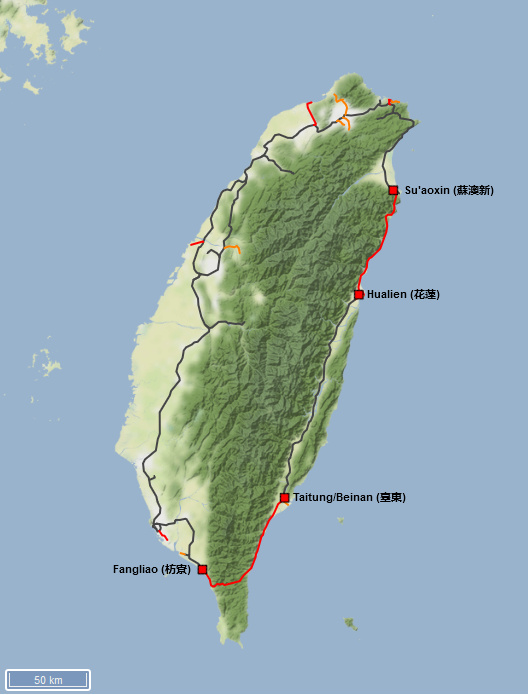 Figure 30: This map shows the Governmental Railway Network on Taiwan Island in 1991 (terrain by Stamen). Non-govermental railways like sugar or forest railways are not shown. Sections marked in red were built between 1959 and 1991, sections marked in grey were built before 1959, sections marked in orange were closed between 1959 and 1991. The openings includes the North and South Link Line on the east coast. Closings affected branch lines, especially in the Taipei area.
The forest and sugar railways were affected even much harder by the economic developments and shrinking importance of sugar and timber exports. Large areas of the forest were cut down by the end of the 1960s and some forest railways closed during that time. The last forest railways on the east coast near Hualien closed latest by the end of the 1980s (see page on forest railways for details). Only the famous Alishan Forest Railway survived thanks to the tourist trains running on the line since the 1960s (see page on Alishan Forest Railway for details). The sugar railways lost much of its passenger traffic already during the 1960s, as many people were able to buy motorbikes thanks to the economic development. In 1953, there were 41 sugar railway lines with passenger traffic (675km in length and up to 60,000 passengers per day). The number shrank to 25 lines in 1961, 17 in 1971 and 3 in 1981. In 1982, the last passenger service on a sugar railway ceased. Transportation figures for sugar cane and sugar products slumped some years after the passenger numbers. More and more sugar mills closed and transportation shifted to roads. By 2020, only two sugar mills are left and only one of them is still using railways for transportation of sugar cane. Some old sugar mills have been transferred into museums and run some heritage trains on short remaining sections of the sugar railway network (see page on sugar railways for details).
 Figure 31: This photo of an abandonded rail car at Xihu sugar factory symbolizes the decline of the once blooming sugar railways (SSR2000, CC BY-SA 3.0
The massive changes for the railways continued in the last three decades. Due to the cape gauge and the often quite curvy alignment, the maximum speed of the trains is limited to 110 to 130km/h. Flights and the meanwhile constructed motorways offered a faster alternative, especially between the two big agglomerations of Taipei and Kaohsiung. The growing commuter traffic on the Western/Trunk Line limited the capacity for further express trains. An extension of the existing double track was not possible due to insufficient space next to the tracks. Thus, the government decided to build a new high-speed railway line between Taipei and Kaohsiung. However, construction and operations were awarded to a private consortium and not to the TRA. As a result, the TRA focused on commuter services along the densely populated west coast, express trains to the east coast and touristic traffic. Further sections of the ring line were double tracked and electrified. By the end of 2020, the complete ring line is electrified. Realignments along the Mountain/Taichung Line and along the east coast as well as the purchase of tilting EMUs helped to shorten travel time. Goods traffic has slumped to a bare minimum. The few remaining goods trains are transporting only bulk goods like oil, cement or corn. The big cities Taipei, Kaohsiung and Taoyuan have started with the construction of rail based metro systems in the late 1980s/1990s and continue to expand those systems.
In 1994, the government approved the construction of a high-speed line between Nangang (南港) in the eastern suburbs of Taipei to Zuoying (左營) in the north western suburbs of Kaohsiung. The line touches all larger agglomerations on the west coast, around 90% of the Taiwanese population lives nearby the high-speed line. In 1997, construction and operation was awarded to the private „Taiwan High Speed Rail Corporation“ (THSRC) under a concession for 35 years. Initially, the THSRC had planned to use trains produced by Eurotrain (a consortium of Siemens and Alstom). However, after the terrible train accident in Eschede/Germany with a Siemens high-speed train and an offer for a very cheap credit by the Japanese government, the THSRC shifted towards Japanese Shinkansen trainsets. The Eurotrain consortium received a compensation payment of 89 Mio. US$. The overall costs for the project amounted to 18 billion US$. The high-speed line runs through the mostly flat plains along the west coast. Around 61km of the line run in tunnels (18% of the total line), the longest being the tunnel underneath the city of Taipei with around 14km; 251km run on bridges (73% of the total line), the longest being a bridge at the end of the line with 157.317km length (at that point of time the longest railway bridge in the world). Trial runs started in 2005, official operations started on 5th January 2007 with train drivers from France and Germany.
At the beginning, the passenger figures were below expectations: expectations were at 140,000 passengers per day, in reality only around 50,000 passengers used the trains per day at capacity utilization rate of 44%. Only by 2015, the initial expected figures were reached with a capacity utilization rate of around 60%. Meanwhile, more than 50 million passengers use the trains per year. Nevertheless, operational profits were already achieved four month after the first train had started. However, due to the high interests and write offs that exceeded earnings by 2.5 times the first operational year closed with a loss of 29 billion NTS (around 1 billion €). Thus, the Taiwanese Government supported the consortium with restructuring of debts and methods for write offs. Since 2010, the consortium reaches an average profit of 3 billion NTS (around 100 million €) after interests and write offs. Between 62 and 80 trains operate per day and direction during the operating times from 6:30 to 0:00. At peak times, a train runs every 10 minutes. Express trains only stop at Taipei, Taichung and Zuoying thus taking 105 minutes for the 345km long trip. Other trains stop at more stations. THSRC only uses Shinkansen train sets of type THSR 700T. Each set consisting of 12 waggons is 304m long and weights 503t. It offers 989 seats (66 business class eats in a 2+2 configuration and 923 second class seats with a 2+3 configuration). The maximum speed of the trains is 300km/h even though the track is designed for a maximum speed of 350km/h. Despite natural disasters as typhoons and earthquakes hit the island regularly, the punctuality rate is at 99.6%.
 Figure 32: The high-speed railway line cuts the the plains on the west coast mostly running on bridges or in tunnels (陳 ポーハン﹝柏翰﹞, CC BY 2.0 [creativecommons.org], via Wikimedia Commons).
 Figure 33: This map shows the high-speed railway line between Nangang (南港) and Zuoying (左營) (relief by Stamen). Lines operated by the TRA are marked in gray.
The TRA tried to shorten travelling times by realigning several lines. In 1998, a tunnel between Sanyi (三義) and Houli (后里) replaced the section running over the mountain range and thus reducing travelling time while enhancing capacity. Nevertheless, after the opening of the high-speed line, the TRA lost most of its express train passengers on the west coast. Thus, the TRA focussed on the commuter traffic in the agglomerations and opened new stations along the lines. Due to the heavy rainfalls and regular earthquakes, there are just a few bridges or underpasses for road traffic. The many railway crossings along the line reduce the maximum speed and are a frequent source for heavy collision accidents. Thus, the TRA continued projects that already started in the 1980s to put the lines either underground or on bridges within the agglomerations (e.g. Taoyuan, Taichung, Kaohsiung). As a side effect, branch lines within these sections were closed. The road network at the east coast is not as good as on the west coast, which makes the TRA much more competitive for traffic. After the opening of the ring line, passenger numbers in trains to the east coast soared to record levels. Thus, the TRA double tracked and electrified more and more sections of the ring line. By the end of 2020, the complete ring line was electrified and all sections except some in the sparsely populated south are meanwhile double tracked. Out of the ten branch lines only four remained in operations (Jiji (集集) Line, Neiwan (內灣) Line, Pinxi (平溪) Line, parts of the Shen’ao (深澳) Line), mainly thanks to rising tourist traffic. In addition, the TRA also tried to introduce special trains on the main lines with special services or comfort (e.g. offering of special lunch boxes) for tourist traffic especially during the holiday season. As some of the stations along the high-speed railway line are quite far away from the city centres, the TRA connected two of them with short branch lines to the existing network of the TRA. This includes the Liujia (六家) Line for Hsinchu (新竹) and the Shalun (沙崙) Line for Tainan (大鵬). The forced closure of several branches and siding led to a further slump in goods traffic. Except a few trains running from the harbours for transportation of containers, coal, corn, and cement trains from the east coast to the agglomerations on the west coast, the goods traffic has ceased more or less completely. In order to cope with the rising commuter traffic, the TRA had ordered and is ordering a large number of new electric rail cars from Japanese and Korean manufacturers within the last three decades. For express trains to the east coast, TRA bought tilting electric multiple units from Japanese manufacturers. The diesel railcars often dating from the 1930s running on the few remaining branch lines were replaced with new diesel railcars from Japan in the 1990s. Only very few new diesel locomotives were ordered as the number of locomotive-hauled trains is steadily decreasing.
| Line | From | To | Length (km) | Opening date | Remark |
| Mountain/Taichung Line | Sanyi (三義) | Houli (后里) | 13.5 | 24.09.1998 | realignment & long tunnel to avoid old mountain section |
| Shalun Line | Zhongzhou (中洲) | Shalun (沙崙) | 5.3 | 02.01.2011 | |
| Liujia Line | Zhuzhong (竹中) | Liujia (六家) | 3.1 | ??.11.2011 | |
| Shen’ao Line | Ruifang (瑞芳) | Badouzi (八斗子) | 4.6 | 09.01.2014 | re-opening of line section closed in 2007 |
| 26.5 |
| Line | From | To | Length (km) | Closing date | Remark |
| Mountain/Taichung Line | Sanyi (三義) | Houli (后里) | 15.9 | 24.09.1998 | closure of old mountain section due to new alignment & tunnel |
| Shenggang Line | Tanzi (潭子) | Oil depot | 13.4 | 01.07.1999 | transformed into bike way |
| East Coast/Taitung Line | Hualien (花蓮) old station | Ji'an (吉安) | 3.6 | ??.??.2001? | branch to old Hualien station (terminus of 762mm line) |
| Taitung (臺東) new station | Taitung (臺東) old station | 6.5 | ??.??.2001 | branch to old Taitung station (terminus of 762mm line) | |
| Donggang Line | Zhen'an (鎮安) | Military camp | 3.6 | 01.07.2002 | re-opening under discussion |
| Shen'ao Line | Ruifang (瑞芳) | Shen'ao (深澳) | 6.4 | 06.09.2007 | line closed after shut down of coal power plant at Shen'ao, section to Badouzi re-openend in 2014 |
| Western/Trunk Line | Gushan (鼓山) | Kaohsiung (高雄) Port Station | 2.6 | ??.??.2008 | track bed planned for Kaohsiung tramway |
| Pingtung Line | Kaohsiung (高雄) Port Station | Kaohsiung (高雄) | 3.1 | ??.??.2008 | |
| Linkou Line | Taoyuan (桃園) | Linkou (林口) | 18.4 | 31.12.2012 | |
| 73.5 |
 Figure 34: This map shows the Governmental Railway Network on Taiwan Island in 1991 (terrain by Stamen). Non-govermental railways like sugar or forest railways are not shown. Sections marked in red were built between since 1992, sections marked in grey were built before 1992, sections marked in orange were closed between since 1992. Most branch lines have been closed. Opened was just a new tunnel section of the Mountain Line near Taichung as well as two short branch lines that connect high-speed railway stations withe the TRA network.
 Figure 35: This diagram shows the development of the railway network length of Governmental Railways on Taiwan including the high-speed line. Marked in blue is the length of the active network, orange depicts inactive/closed/dismantles lines. The maximum of the network was reached in 1991 (opening of the South Link Line) as long as the high-speed line is not taken into account.
The TRA continues to focus on commuter traffic. In 2008, commuter traffic generated 43% of all passenger-kilometres from an overall of 179 million passengers and 8.7 billion passenger-kilometres. Within ten years, the passenger numbers climbed to 231 million passenger mainly due to the growing commuter traffic on the Western/Trunk Line (90% of all passengers are recorded on this line). While passenger numbers are still growing thanks to the commuter traffic, goods traffic numbers are decreasing further and further. In 2008, the TRA only transported 9.5 million tons of goods (58% container, 26% cement and 9% coal). The small loading gauge of most lines restricts transport of containers. In 2008, earnings out of ticket sales amounted to around 434 million US$ with a further 28 million USD from goods transports. The earnings covered only around 40% of the cost that especially result from high labour costs, pension reserves and interest payments. By 2008, the TRA had accumulated a deficit of 3.6 billion US$. Nevertheless, government and politics insist on relatively low fares, large number of employees and high frequency of trains even in sparsely populated areas. The average age of the employees is rather high and the TRA has problems to find young people that accept the rather low wages being paid by the TRA. These are all problems well known to many other Government Railways around the world. In the recent past, two terrible train accidents hit the TRA. On 21st October 2018, a train derailment near Yilan caused by excessive speed resulted in 18 deaths. On 2nd April 2021, a train derailment caused by a construction truck that had fallen onto the tracks resulted in 49 deaths.
While Non-Governmental Railways like forest, sugar or mining railways have disappeared except a few lines used for tourist traffic, metros as a new type of railways have emerged in recent years. The massive growth of population and car traffic in the agglomerations required the big cities to take action. The city of Taipei started its first metro line on 28th March 1996. In 2016, the city already operated five lines with a total length of 131.1km transporting around 750 million passengers per year. The metro system in Kaohsiung started on 9th March 2008. Meanwhile two lines with a total length of 42.7km are in service along a tramline that opened in 2017. Also in 2017, the first metro line in Taoyuan opened. Further information on the metro systems can be found at the subsite for metro systems.
.jpeg) Figure 36: This is how modern traffic on the TRA main lines looks like. A tilted electric multiple unit of class TEMU2000 on the Taitung Line near Hualien. Fifty years ago, steam-hauled trains were pulling slow mixed trains on 762mm gauge on this line. By now, the former isolated Taitung Line had been connected to the railway network on the island, re-gauged to 1,067mm, double-tracked and electrified (Cho Hsun Lu, CC BY 3.0
Figure 36: This is how modern traffic on the TRA main lines looks like. A tilted electric multiple unit of class TEMU2000 on the Taitung Line near Hualien. Fifty years ago, steam-hauled trains were pulling slow mixed trains on 762mm gauge on this line. By now, the former isolated Taitung Line had been connected to the railway network on the island, re-gauged to 1,067mm, double-tracked and electrified (Cho Hsun Lu, CC BY 3.0  Figure 37: The few remaining branch lines as the Neiwan Line shown in the picture are operated with diesel rail cars and mostly serve tourist traffic (Dquai, CC BY-SA 4.0
  Figure 38: Alongside the two metro lines in Kaohsiung, there was also a new tramway being built in recent years. Large parts of the new tramway use the track bed of the old port lines that were closed some years before. The trams are running with batteries, which are charged during the stops at the stations.
Since the 1970s, the TRA has had a hard time due to the hard competition from road, air and high-speed traffic. In particular, the long-distance transport shrinks from year to year. The TRA only sees increases in passenger traffic within the metropolitan area. Here, the TRA offers commuter transport on its routes and tries to get more shares in the commuter traffic, e.g. by connecting remote HGV stations to the rest of the network (Shalun and Liujia lines) or expanding the routes like a metro (e.g. Taichung). In 2008, three out of four passengers were traveling in suburban traffic, 43% of all passenger kilometers amounted in suburban traffic. In total, the TRA carried 179 million passengers at 8.7 billion person-kilometers in 2008. By 2018, the number of passengers rose to 231 million. More than 90% of the passengers were carried on the main route ("Western Line"), although the TRA is in direct competition there with the HGV route. Long-distance trains are mainly used by students and poorer sections of the population due to the low prices; the trains are usually fully booked only during the vacation and public holiday season. The TRA is also trying to gain a foothold in tourist traffic using special trains with special food services and panorama cars.
&The TRA hardly plays any role in freight traffic. In 2008, only 9.5 million tons of goods (58% containers, 26% cement and 9% coal) were transported over an average of 481 ton miles, the income amounted to just US $ 28 million. Container traffic in particular is restricted due to the small railway loading gauge.
&In 2008 TRA generated US $ 434 million revenues from ticket sales and US $ 28 million in revenue from freight transport, thus covering only 40% of the expenses and costs. In particular high personnel costs, pension burdens and comparatively high interest payments resulted in an accumulated deficit of over 3.6 billion US $. Nevertheless, the relatively low ticket prices are politically desirable, as are the lavish staff and the rather dense range of trains in the more remote regions. Practically all train stations are still manned, and as in Japan, there are additional supervisory staff for every platform at the larger train stations. At the same time, the TRA is also struggling with personnel concerns. The average age of the employees is close to the retirement age, young people who accept the very low wages are difficult to find.
 Figure 39: As here in Taichung goods station, freight traffic at TRA is unfortunately largely put aside (Cheng-en Cheng, CC BY-SA 2.0
The private high-speed rail consortium THSRC (Taiwan High Speed Railway Consortium) built and operates the high-speed rail link between Taipei and Kaohsiung under a 35-year concession. As early as the 1980s, there were plans to build a high-speed line that would connect all the metropolitan areas in the western area of Taiwan. Finally, in 1994 the Taiwanese government decided that a private consortium and not the TRA should build and operate the high speed line. In 1997 the THSRC won the tender based on trains from Eurotrain (consortium of Alstom and Siemens). However, the THSRC struggled to raise the necessary capital. Thus, a loan offer from the Japanese government was gratefully accepted, which was, however, connected to the purchase of Japanese Shinkansen technology. Finally, the THSRC reached an agreement on compensation of US $ 89 million was with the Eurotrain consortium.
The project cost a total of US $ 18 billion. The route runs largely through the relatively flat coastal plains in western Taiwan where more than 90% of the total population lives. 61 km (18% of the total distance) runs in tunnels (the longest tunnel is the underground tunnel in Taipei with a length of 14 km), 251 km (73% of the total distance) runs on bridges (of which the longest bridge at the southern end of the route makes up more than half with its length of 157.317km). The first trial runs began at the beginning of 2005, and operations started on January 5, 2007, initially with German and French train drivers.
The number of passengers was initially far below expectations, instead of the expected 140,000 passengers per day just 50,000 were reached, the capacity utilization of the trains was at 44%. The initial estimated figures were only reached in 2015, and the train load factor is now almost at 60%. The consortium already posted operational profits in the fourth month of operations. However, due to the high depreciation and interest charges (they exceeded the earnings by 2.5 times!) the company closed the first operational year with a loss of 29 billion NTS (approx EUR 1 billion). The Taiwanese government supported the consortium in restructuring the debt and allowed lower depreciation calculations, which helped the consortium to generate a profit of NTS 3 billion (approx. EUR 100 million) after depreciation and interest since 2011.
Trains run between 6:30 am and midnight, around 62 to 80 trains services are offered per day in each direction, at peak times a train departs every 10 minutes. There are express trains, which take around 105 minutes for the 345km in distance by only stopping in Taipei, Taichung and Kaohsiung; other trains stop at more intermediate stations resulting in a longer travel time. Only Shinkansen trains of the THSR 700T series are used on the line. The multiple units are 304m long, weight 503t, consist of 12 cars and offer 989 passenger seats (66 in business class in 2 + 2 configuration, 923 in 2nd class in 2 + 3 configuration). The trains run at a maximum speed of 300 km / h, the route itself is designed for maximum speeds of up to 350 km / h. The punctuality rate is above 99.6% despite the numerous natural events (typhoons, earthquakes) that regularly haunt the island.
 Figure 40: One of the many high speed trains that daily travel between Taipei and Kaohsiung (Encino from zhwiki, Public domain, via Wikimedia Commons).